The New York City Market Analysis For Small Business Opportunity
New York City is one of the most “rewarding-but-unforgiving” markets in the world: the upside is massive demand density (millions of residents plus tens of millions of visitors), but the competition, costs, and customer expectations are equally intense. In this analysis, we’ll break down what makes NYC such a unique small-business arena, how the city’s demographics and movement patterns shape buying behavior, where the strongest demand pockets are (and why “NYC” is really dozens of micro-markets), what gaps still exist despite the saturation, and how a small business can position itself to win—especially through smarter targeting, clearer differentiation, and stronger trust signals online.

NYC demographic context (for this analysis)
- Population is estimated at ~8.48 million (July 1, 2024). NYC Government
- Foreign-born residents: 36.5% (2019–2023)—a major driver of multicultural demand and multilingual marketing needs. Census.gov
- Language other than English spoken at home: 47.5% (age 5+, 2019–2023)—translation, cultural fluency, and community-based targeting matter here. Census.gov
- Median household income: $79,713 (2019–2023, 2023 dollars)—but with big neighborhood variation. Census.gov
- Poverty rate: 17.4% (2019–2023)—means value tiers and pricing strategy can’t be an afterthought. Census.gov
- Mean commute time: 40.6 minutes (2019–2023)—convenience wins, and timing/geo-targeting matters. Census.gov
- Households with broadband: 89.0% (2019–2023)—digital discovery is a primary battleground. Census.gov
The NYC Small Business Opportunity Landscape
NYC’s core advantage is stacked demand: a resident base of ~8.48M plus a world-class visitor economy that brought ~64.3M travelers in 2024, generating ~$79B in total economic impact and >$51B in direct spending—the kind of constant inflow that few cities can match. NYC Government+1 On top of that, NYC is home to 183,000+ small businesses (2023) and still adding more—new business formation has outpaced closures, with ~62,000 small businesses started between Oct 2021 and Sep 2023. NYCEDC That combination tells you two truths at once: (1) opportunity is real because money and movement are real, and (2) “good enough” won’t survive because the market regularly produces new competitors and customer options.
NYC Market Facts Every Owner Should Know
NYC’s economy isn’t just big—it’s multi-engine: the city posts enormous activity across everyday categories that small businesses can realistically touch, including ~$169.2B in retail sales (2022) and ~$43.7B in accommodation/food services sales (2022), with huge related flows through transportation/warehousing and health/social services. Census.gov The city also has a massive employer ecosystem—194,269 employer firms (2022)—which matters because B2B and “sell-to-business” models can be just as powerful as consumer retail if you target the right corridors and industries. Census.gov And because NYC customers are constantly comparing options (often in real time on their phones), your operational basics—speed, clarity, reliability, reviews, and customer experience—aren’t “nice to have”; they’re table stakes.
Where the Gaps Are: Underserved Needs and White Space
The biggest misconception about NYC is that “everything already exists”—the reality is that distribution is the gap. Many neighborhoods still lack reliable, well-branded, easy-to-book services that are hyper-local, multilingual, transparent on pricing, and consistent in delivery. Opportunities often show up where customers are tired of uncertainty: unclear quotes, no-shows, slow response times, confusing websites, or businesses that don’t understand specific communities (language, cultural expectations, preferred communication channels). In a market with long commutes and nonstop schedules, the winners frequently aren’t “the most creative”—they’re the most frictionless: fast scheduling, clear offers, tight service areas, strong guarantees, and customer education that reduces hesitation.
The Borough-and-Neighborhood Reality: Micro-Markets, Not One City
If you treat NYC like a single market, you’ll waste money and blur your message; the city behaves like a network of smaller cities with different customer profiles, spending power, and purchase triggers—often block by block. That’s why the smartest small businesses build a neighborhood strategy: choose a tight initial footprint (specific parts of a borough), align your offer to what those residents actually value (speed vs. luxury vs. price vs. trust), and then expand in rings once referrals and reviews start compounding. This is also where SEO and paid ads become unfair advantages—because in NYC, the businesses that win search visibility at the neighborhood level can dominate “high intent” demand without needing to be famous citywide.
Tourism, Events, and “Visitor Money” as a Demand Multiplier
Tourism isn’t just a hospitality story—it’s a small-business demand engine that spills into dining, retail, experiences, transportation, and niche convenience services across all five boroughs. In 2024, NYC’s visitor economy was forecast at 64.3M visitors, with ~13M international visitors accounting for roughly half of visitor spending, and the activity supported 388,000+ leisure and hospitality jobs while generating >$6.8B in tax revenue. New York City Tourism + Conventions For small businesses, the play is simple: align your messaging and availability with the city’s recurring surges (holiday seasons, summer travel, major events), and create “tourist-friendly” funnels—clear location info, hours, transit notes, quick booking, and review-focused credibility—because visitor purchasing decisions compress into minutes.
The Review Economy and Trust Signals That Drive Purchases
NYC customers are uniquely skeptical because they’ve been burned before—so trust is a growth lever, not branding fluff. The businesses that win consistently in NYC make trust visible: sharp photos, specific service descriptions, transparent pricing ranges, strong before/after proof, clear policies, and a steady stream of reviews that mention reliability and outcomes. In a city with endless options, trust signals reduce decision fatigue—meaning you’re not just “marketing,” you’re lowering the customer’s perceived risk. This is why local SEO (maps visibility + reviews + relevance) is often more profitable than broad awareness campaigns: it puts you in front of buyers already searching for what you do.
Diversity and Language: Winning Multilingual and Multicultural Segments
NYC’s diversity isn’t a footnote—it is the market. With 36.5% foreign-born residents and 47.5% speaking a language other than English at home, you can build a real moat by being culturally fluent and operationally prepared: translated landing pages, bilingual staff or answering, culturally relevant creatives, and ad/SEO targeting that aligns with community hubs. Census.gov Many small businesses leave money on the table by using one generic message for everyone; in NYC, even small localization tweaks (language, imagery, neighborhood references, community-specific offers) can dramatically improve conversion because they signal “this was made for me.”
Cost Structure: Rent, Labor, and Compliance—How Winners Stay Lean
NYC can punish bloated models, so lean operations are often the difference between surviving and scaling. The strongest small businesses minimize fixed costs early (tight footprints, appointment batching, mobile/on-site service models, shared spaces where possible), then invest in demand capture (SEO, reviews, retargeting, partnerships) so every dollar spent drives measurable leads. The smarter approach isn’t necessarily “cheaper”—it’s more controlled: you want predictable margins, shorter sales cycles, and fewer wasted trips in a city where time is expensive and logistics are complex. When you combine lean operations with strong digital trust signals, you can often charge healthier prices because customers will pay for certainty.
Digital Demand: Search Behavior, Broadband, and E-Commerce Expectations
NYC is an online-first discovery market, and the data supports why: 89% of households have broadband, meaning your website and local presence are often the first “storefront” someone experiences. Census.gov That makes website speed, clarity, mobile UX, and neighborhood-specific relevance critical—especially because customers frequently compare multiple providers quickly. For many service businesses, the goal isn’t to “go viral,” it’s to own the bottom-of-funnel searches (near me, borough + service, neighborhood + service, emergency/24-hour intent) and convert that traffic with proof, clarity, and frictionless calls-to-action.
Competitive Positioning: How to Differentiate When Everyone Offers “Great Service”
In NYC, “great service” is not positioning—it’s a baseline claim everyone makes. Differentiation comes from specificity: who you serve (neighborhoods + niche segments), what problem you solve (one clear primary pain), how you deliver (speed, guarantee, process), and why you’re trusted (proof and consistency). The businesses that break through tend to build an identity that’s easy to repeat and easy to recommend: one-liner clarity, a simple offer ladder, and a customer experience designed for referrals. In a city with 183,000+ small businesses and constant new entrants, your advantage is rarely being “bigger”—it’s being sharper. NYCEDC
FAQ
What’s the biggest mistake small businesses make when entering NYC?
Trying to market to “all of NYC” with one generic message. NYC is a collection of micro-markets; you win by choosing a tight geographic footprint, a clear niche, and a strong offer that matches local demand.
Which business models tend to work best in NYC right now?
Models that reduce friction and prioritize convenience: appointment-based services, subscription maintenance, mobile/on-site delivery, and highly review-driven local businesses that are easy to book and easy to trust.
How important is tourism to small businesses that don’t feel “touristy”?
More important than most owners realize. Visitor spending spills into everyday categories—food, retail, transportation, experiences, and convenience—and it can change demand patterns by neighborhood and season.
New York City Tourism + Conventions
How should I think about pricing in NYC?
NYC has both premium and value segments, often in close proximity. The key is matching your pricing to your positioning and your neighborhood footprint, then making your value obvious through proof, process, and guarantees.
What’s the fastest way to improve lead flow in NYC without massive ad spend?
Local SEO fundamentals (service + neighborhood relevance, strong on-page clarity, and consistent review generation) paired with a conversion-first website. NYC buyers move fast; you want to show up and remove doubt quickly.
Is NYC too saturated for new small businesses?
Saturation is real, but so is churn and shifting demand—NYC continues producing new businesses and new gaps. The winners aren’t the first to market; they’re the clearest, most trusted, and most operationally consistent.
NYCEDC

The Top 5 Small Businesses That Would Be Perfect In Today's New York City Based Off The Market Analysis:
1) Neighborhood “Rapid-Response” Home Services (Handyman + Small Repairs + Installations)
New York is overflowing with apartments, co-ops, condos, and small commercial spaces that constantly need quick, reliable fixes—yet the market is still full of no-shows, vague pricing, and long scheduling windows. A tight-scope, rapid-response home services business (think: mounting TVs, furniture assembly, light fixture swaps, drywall patches, minor plumbing fixes, smart lock installs) fits NYC perfectly because it directly solves the city’s biggest pain point: people are busy, time is scarce, and they’ll pay for certainty and speed.
The winning angle is to operate like a “service product,” not a traditional contractor. You’d offer transparent packages, same-day or next-day booking windows, and a frictionless experience that works on mobile in under a minute. To stand out, focus on a few neighborhoods first, build reviews aggressively, partner with property managers and supers, and create a referral loop with local realtors, cleaning crews, and moving companies. In NYC, trust is a multiplier—if your website makes you look credible and your service is consistent, word-of-mouth spreads fast inside buildings and blocks.
2) Laundry Pickup + Delivery for Buildings and Busy Professionals
NYC has a built-in demand engine for laundry logistics: limited in-unit washers/dryers, dense apartment living, and high numbers of working professionals who value convenience. A small laundry pickup/delivery operation can still be “perfect” today because the gap isn’t that laundry doesn’t exist—it’s that the experience is often inconsistent, hard to schedule, and not designed around modern expectations for tracking, texting, and reliability.
The most defensible version of this business is hyper-local and relationship-based: start with a handful of buildings, lock in recurring pickups, and make it ridiculously simple with set pickup days, clear pricing, and text updates. Your differentiation can be quality control (photo verification of issues, separated loads, precise folding standards), speed (24–48 hour turnaround), and trust (customer-specific notes, concierge-style service). Market it at the building level with doormen/supers and local partnerships, then scale neighborhood by neighborhood once routes become efficient.
3) Short-Term Rental Turnover Service (Cleaning + Linen + Restock + Quality Checks)
Even with saturation in general cleaning, NYC still has a meaningful gap in “hospitality-grade turnover” for short-term rentals and furnished stays, especially for hosts who manage multiple units or travel frequently. What makes this perfect today is the combination of tourism demand and the sheer cost of a bad guest experience—one sloppy turnover can create a negative review that hurts bookings immediately, so owners will pay for a team that is consistent, checklist-driven, and dependable.
To win, you’d package it as a complete turnover system: cleaning, linen swaps, restock essentials, and a photo-based completion report that removes uncertainty. You can differentiate by specializing in specific neighborhoods and building types, offering fast resets between check-out and check-in, and keeping strict standards that mimic hotels. The marketing is straightforward: target hosts, property managers, and mid-term rental operators with proof (before/after galleries, checklists, review screenshots) and make booking and communication effortless so you become the “default choice” after the first great experience.
4) Mobile Notary + Document Courier (Fast, Trust-Based Convenience Service)
In NYC, people constantly need documents signed, delivered, and handled quickly—often under time pressure—yet the process is still surprisingly inconvenient for many. A mobile notary and document courier service is “perfect” because it matches the city’s friction problem: clients don’t want to travel, wait, or coordinate complex logistics; they want a professional to show up where they are, communicate clearly, and get the job done without drama.
The key is positioning it as a premium convenience brand rather than a commodity. You’d offer fast scheduling, clear service areas, transparent fees, and a calm, professional experience that earns trust instantly. For marketing, you’d target neighborhood searches, build relationships with real estate professionals, small law offices, accountants, and healthcare-adjacent providers, and lean hard into reviews and credibility signals. You’re not trying to “market to all of NYC”—you’re trying to become the highest-trust option in a few neighborhoods first, then expand once your reputation compounds.
5) Niche, Neighborhood-Based Food Concept (Micro-Catering / Meal Prep / Grab-and-Go for a Specific Audience)
NYC food is famously competitive, but that’s exactly why a niche food concept can be perfect today—if it’s engineered around a clear audience and a repeatable buying habit. The market gap isn’t “people need food”; it’s that people need food that matches their lifestyle with minimal friction: office lunches, medical staff shifts, fitness-focused routines, dietary restrictions, or culturally specific comfort food that’s hard to find in certain neighborhoods.
The winning play is to pick one audience and one neighborhood cluster, then build consistency and convenience: pre-ordering, scheduled pickup windows, delivery partnerships, and a menu that’s simple enough to execute flawlessly. You differentiate with clarity (who it’s for, what problem it solves), speed (easy ordering and predictable fulfillment), and trust (freshness, quality control, reviews, and strong visuals). In NYC, you don’t have to be everything to everyone—you only need to be the obvious choice for a specific group of people who buy repeatedly in the same few square miles.
Joshua Lee Bryant
Advertising | Coaching | Web Design
Powerful, strategy-driven solutions for small to large businesses ready to gain more customers and grow.





My Services
Let's Grow Your Business | Coaching
Behind every thriving business is a strong strategy and a trusted advisor. My consulting services offer expert insight, personalized guidance, and a collaborative approach that puts your goals first. Whether you're just starting or scaling up, I’ll help you move forward with clarity and confidence.
Your next step is just one conversation away.

Business growth doesn’t happen by chance, it happens when your offer, pricing, messaging, and customer acquisition system all work together. We’ll identify what’s holding you back, build a clear and realistic strategy, and then connect it to execution across the platforms that drive results.
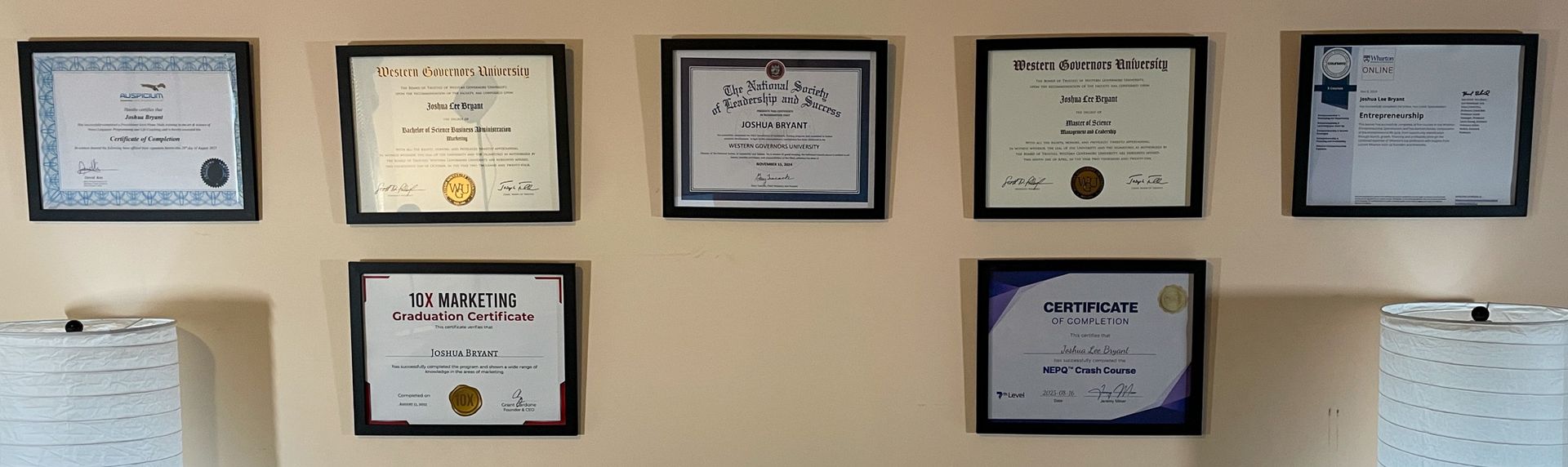
You need to be able to trust that the person helping your business is properly qualified to do the job, as your budget, brand, and growth are at stake. I’m a business major, author, and experienced mentor who has helped 200+ businesses and taught small business development workshops through organizations like the SBDC, People Inc, and the YWCA. Backed by formal education (MSML and a BSBA in Marketing), advanced training in business strategy and entrepreneurship, and certifications in marketing and sales frameworks, I bring both strategic depth and real-world execution to every engagement, so your growth plan is built on skill, not guesswork.

Free Consultation
Ready To Accelerate Your Business To New Heights? I'm here to help. Fill out this form and I will promptly reach out to you for a Free Consultation!