The Los Angeles Market Analysis For Small Business Opportunity
Los Angeles is one of those markets where almost any good small-business idea can work—and where almost any weak execution gets punished fast. You’ve got massive population density spread across a huge footprint, neighborhood “micro-economies” with totally different buyer behavior, and a constant inflow of visitors, talent, and capital. In this analysis, we’ll ground the opportunity in real numbers (size of the market, spending signals, mobility and lifestyle constraints), then translate that into what it means for product/service positioning, location strategy, marketing channels, and what kinds of gaps are still wide open for founders willing to serve LA the way LA actually functions.

Key LA demographics (context that shapes demand): Census.gov+1
- Population estimate (July 1, 2024): 3,899,449
- Under 18: 19.5% | 65+: 13.8%
- Hispanic or Latino: 47.2%
- Foreign-born (2019–2023): 35.8%
- Language other than English at home (age 5+, 2019–2023): 56.8%
- Bachelor’s degree or higher (age 25+, 2019–2023): 37.8%
- Median household income (2023 dollars, 2019–2023): $80,366
- Poverty rate: 16.5%
- Mean commute time: 31.1 minutes
- Broadband subscription (2019–2023): 91.3%
- Land area (2020): ~469 sq. miles
Why Los Angeles Is a High-Volume, High-Variance Small-Business Market
LA is not just “big”—it’s high-velocity. Even at the city level, the spending signals are massive: total retail sales were about $81.35B in 2022 (about $21,281 per capita), and accommodation/food services sales were about $17.37B—a direct indicator of how much money is constantly flowing through consumer-facing categories. Add the business base—over 108,000 employer firms (reference year 2022)—and you’re looking at a market where competition is thick, but so is demand; the winners aren’t always the biggest, they’re the most sharply positioned and the most discoverable in the right pocket of the city. Census.gov
Local Context Every Operator Should Know (Geography, Density, and Daily Life)
Los Angeles is a sprawling city (about 469 square miles of land area) that behaves less like one downtown-centric metro and more like a network of connected hubs—DTLA, the Westside, the Valley, Hollywood, South LA, East LA, and countless neighborhood corridors where foot traffic, income mix, and cultural preferences change dramatically within a few miles. That sprawl shows up in lifestyle patterns: the mean commute is about 31.1 minutes, and that reality shapes what people buy (convenience wins), when they buy (time windows matter), and which businesses become habits (anything that reduces friction). If you’re building in LA, you’re not just competing on price or quality—you’re competing against traffic, time scarcity, and customer overwhelm. Census.gov+1
Where the Gaps Are: What LA Customers Still Can’t Get Easily
The biggest “gaps” in LA are rarely about a product not existing; they’re about delivery: speed, trust, clarity, language access, and consistency. With 56.8% of residents speaking a language other than English at home and 35.8% being foreign-born, there are huge opportunities for businesses that serve customers bilingually (or multilingual) without making it feel like an afterthought—especially in health-adjacent services, home services, education/tutoring, legal support admin, and high-trust local trades. Combine that with a city where internet adoption is high (broadband ~91.3%), and the gap becomes obvious: many local providers still have weak online presence, thin reviews, confusing service pages, or no clear “next step,” even though customers are searching constantly. Businesses that package what they do clearly, earn reviews intentionally, and win local search can take market share faster here than in many smaller cities—because demand is already there and buyers are already looking. Census.gov
Neighborhood Micro-Markets: Treat LA Like 20 Cities, Not One
A common small-business mistake in LA is trying to market “to Los Angeles” as if it’s one audience. In practice, each neighborhood cluster behaves like its own city with its own price tolerance, aesthetic expectations, cultural signals, and preferred channels. The play is to pick a beachhead: one to three neighborhoods where your offer makes the most sense, then build density—reviews, repeat customers, partnerships, and local visibility—before expanding. This is especially powerful for services with route efficiency (cleaning, mobile detailing, repairs, wellness services, photography, catering, pet services) where you can increase margins simply by reducing drive time and stacking appointments in a tight zone.
Tourism as a Demand Engine (and How to Capture It Without Relying on It)
Tourism is not “extra” in LA—it’s a major demand layer. In 2023, 49.1 million people traveled to Los Angeles, generating $40.4B in business sales and supporting 530,000+ tourism-related jobs—meaning there are entire customer segments that refresh constantly. The smartest small businesses don’t build only for tourists; they build for locals first, then add tourist capture: location-based offers, “near me” SEO pages, partnerships with hotels/hosts, and high-intent paid search during peak seasons. If you can serve both audiences with different entry points (locals = subscriptions/loyalty; visitors = high-margin one-time experiences), you stabilize revenue while still benefiting from LA’s visitor volume. Discover Los Angeles
Ports, Airports, and Logistics: Why LA Is a Physical-Commerce Superhub
If your business touches physical goods—retail, e-commerce, importing, distribution, packaging, subscription boxes, specialty foods, or B2B supplies—LA’s logistics footprint is a competitive advantage. The Port of Los Angeles alone handled about 17% of U.S. containerized waterborne international trade in 2024 (about 6.7 million loaded TEUs), and combined with Long Beach, the San Pedro Bay complex handled about 31% of U.S. containerized waterborne trade. Layer in air connectivity: LAX processed about 76.59 million passengers in 2024 (with roughly 23.99M international and 52.60M domestic), reinforcing LA as a constant gateway market. The opportunity for small business is clear: speed-to-shelf, niche importing, localized distribution, and premium “made/assembled in LA” positioning can all be leveraged when the supply chain is literally in your backyard. Port of Los Angeles+1
The Creative Economy Advantage: Branding, Content, and Experience Matter More Here
LA’s cultural gravity turns “good enough” branding into a liability. In many cities, a plain website and a few ads can carry a business; in LA, customers are exposed to world-class creative daily, so they subconsciously judge legitimacy faster. That doesn’t mean you need a Hollywood-level budget—it means you need coherence: one clear promise, one clear audience, proof (reviews/results), and a consistent look across web, socials, listings, and signage. The upside is that strong creative execution amplifies faster here than in quieter markets, because word-of-mouth spreads through communities, creators, and niche networks at high speed.
Cost Reality Check: Rent, Labor, and Compliance—and Practical Ways to Win Anyway
LA can punish sloppy economics: rent, insurance, and labor costs can squeeze margins, and the market’s competition can tempt owners into discounting. The winning counter-strategy is to design your offer around margin protection: bundles instead of à la carte, memberships/subscriptions for recurring revenue, route density for service businesses, and “premium clarity” (clear deliverables + clear timelines + clear guarantee boundaries) so price becomes secondary. Also consider how income dispersion affects pricing: the median household income is about $80,366, but poverty is about 16.5%, which means you’ll often do better with tiered offers (good/better/best) than with a single price point. Census.gov
Digital Discovery in LA: Reviews, Maps, and Multilingual Search Are the Front Door
Because broadband access is high and competition is dense, discovery happens online first—especially in Maps results, “near me” searches, and review platforms. The LA-specific edge is multilingual discovery: if over half the city speaks a language other than English at home, the businesses that build service pages, FAQs, and Google Business Profile content with multilingual intent (without being spammy) can outrank better operators who simply aren’t readable to the customer in their preferred language. The goal is not “more content”—it’s more relevance per neighborhood: service + neighborhood pages, photos that match the local area, review generation systems, and content that answers purchase questions quickly. Census.gov
Go-to-Market Blueprint: How to Test, Launch, and Scale in 90 Days
A practical LA launch is a sequence: pick one micro-market, validate demand with a tight offer, then scale visibility only after the service delivery is airtight. In the first 30 days, the mission is proof—reviews, before/after results, short-form content, and a clean web page that converts. Days 31–60 are about distribution—local SEO pages, partnerships (property managers, gyms, salons, churches, coworking spaces, HOAs), and a small paid search budget aimed at high-intent queries. Days 61–90 are about compounding—retargeting, referral loops, email/SMS follow-up, and expanding into the next adjacent neighborhood only when you can maintain response time and quality. LA rewards speed, but it punishes inconsistency—so scaling should follow operational capacity, not ego.
FAQ
What’s the single biggest mistake small businesses make when entering Los Angeles?
Treating LA like one market instead of many. When you market too broadly, you compete with everyone. When you pick a neighborhood cluster and tailor your message, you become the obvious choice for that pocket.
Which types of businesses tend to win fastest in LA?
The ones that reduce friction: convenience, speed, trust, and clarity. Anything that saves time or removes uncertainty (clear pricing, online booking, fast response, strong reviews) has a built-in advantage.
How important is tourism for a new small business in LA?
Tourism can accelerate revenue, but it shouldn’t be your only foundation. The best approach is “locals-first with tourist capture”—build recurring local demand, then add visitor-focused entry points as a second layer.
Discover Los Angeles
Does it still make sense to start a brick-and-mortar business in LA?
Yes—if the location matches the customer and you have a discovery plan. A storefront without a map/review strategy is invisible; a storefront with strong local SEO, photos, and reviews can become a neighborhood default.
What marketing channels matter most for LA small businesses right now?
Local search (Google Business Profile + reviews), neighborhood-specific landing pages, and high-intent paid search for bottom-of-funnel queries. Social can be huge too, but it works best when it supports a clear offer and a clear niche, not when it’s random content.
How do I price in a market with both high incomes and real poverty?
Use tiered pricing. Offer a clear “entry” option, a strong core offer, and a premium version with priority speed or added value. LA’s income spread makes one-size pricing less effective than structured choice.

Top 5 Small Business Ideas For Los Angeles (Based Off Analysis)
1) Mobile Car Detailing and “Fleet-Ready” Cleanups for Busy Neighborhoods
Los Angeles is built around driving, which creates nonstop demand for car care—but the real opportunity is not “detailing exists,” it’s that most options still require inconvenience: dropping off, waiting, or navigating hard-to-book shops. A premium mobile detailing business that targets specific clusters (Westside, Valley pockets, DTLA high-rise zones, South Bay, etc.) fits LA perfectly because it turns a time-consuming task into a frictionless service. If you position it around convenience, reliability, and clear packages—basic refresh, deep interior, pet hair, stain treatment, ceramic maintenance—you’re selling time back to customers in a city where time is the most precious currency.
The win is operational and marketing-driven: route density, subscription plans, and trust signals. Create recurring monthly memberships for commuters and parents, and a separate “fleet-ready” offer for realtors, rideshare drivers, small delivery operators, and boutique businesses with company vehicles. Then stack your days by neighborhood to reduce travel time, build local reviews fast, and use content that shows real outcomes (before/after). In LA, a mobile detailing business becomes a neighborhood staple when it is easy to book, always shows up on time, and delivers consistent results that people can see instantly.
2) Short-Term Rental Turnover Service (Cleaning + Linen + Restock + Photo Proof)
LA’s tourism volume and the ongoing demand for furnished stays create a consistent need for professional turnover service—but the gap is in consistency and accountability. Many hosts struggle with cleaners who don’t meet hospitality standards, missed items, incomplete resets, or unreliable scheduling when check-in windows are tight. A specialized turnover service is perfect for LA because it’s built for repeatability: every property needs the same cycle, every booking creates a deadline, and every bad reset costs the host revenue and reviews.
The most valuable version of this business is a “system,” not a cleaning crew. You deliver a checklist-based turnover, linen coordination, restock of essentials, and a photo report that removes uncertainty for hosts and property managers. You can differentiate by neighborhood specialization, fast reset options, and consistent quality control, which is exactly what a competitive hospitality market demands. Once you become the trusted operator for a small portfolio in one area, the growth path is natural: referrals spread quickly among hosts, and expanding route density improves margins rather than hurting them.
3) Bilingual Home Services Concierge (Handyman + Minor Repairs + Installations)
LA has a huge opportunity for bilingual, trust-first home services because the market is large, diverse, and full of homeowners and renters who need help with small repairs—but don’t want the hassle of unclear pricing, inconsistent communication, or language barriers. A modern handyman model that’s positioned as a “home services concierge” can be perfect here: mounting, assembly, smart home installs, minor drywall, faucet swaps, door hardware, weather stripping, and punch-list work—high demand, repeatable tasks that many contractors ignore because they prefer larger jobs.
The competitive edge is not just bilingual capability—it’s packaging and professionalism. Offer transparent pricing tiers, same-day or next-day booking windows, and text-based updates that make customers feel in control. Partner with property managers, real estate agents, and local contractors who don’t want small jobs, and you can build a steady pipeline fast. In LA, this type of business wins by reducing uncertainty and making the customer experience feel modern: fast booking, clear deliverables, and a reliable technician who shows up and gets it done without drama.
4) Premium Meal Prep + Micro-Catering for Specific Lifestyle Niches
LA is full of “food,” but there’s still a massive gap in consistent, lifestyle-aligned meal solutions that feel high quality and easy to maintain. This is a city where fitness, wellness, entertainment schedules, and time scarcity collide—meaning people want meals that match their goals without daily decision fatigue. A meal prep and micro-catering business can be perfect if it serves a clearly defined niche: high-protein fitness plans, plant-based convenience, family-friendly weekly bundles, gluten-free comfort meals, or culturally specific menus that are hard to find in certain neighborhood clusters.
What makes this business win in LA is clarity and operational discipline. A tight menu, predictable pickup/delivery windows, and subscription ordering turn “one-time buyers” into weekly customers. You don’t need to be a citywide brand—you need to dominate one neighborhood cluster with a repeatable routine and strong visuals. Create partnerships with gyms, studios, med spas, and coworking spaces, and your distribution becomes community-driven rather than ad-driven. In LA, a niche food concept scales best when it’s built around habits and identity, not novelty.
5) Multilingual Digital Presence Studio for Local Businesses (Photos, Short Video, Listings, Reviews)
This is an LA-specific business opportunity that most people overlook: thousands of local businesses still have weak digital storefronts—bad photos, inconsistent branding, outdated websites, thin Google profiles, and no review strategy—despite living in one of the most media-driven markets on earth. A “digital presence studio” is perfect in LA because the city is uniquely visual, competitive, and diverse. Businesses that look credible online get chosen, and businesses that look dated get ignored—especially when customers are comparing options on mobile in seconds.
The winning model is productized and bilingual/multilingual where needed: a one-day “business makeover” package that includes updated photos, short-form video clips for ads/social, Google Business Profile optimization, review-request systems, and basic on-page improvements for local search. This is not generic marketing—it’s “make you look legit and easy to trust” in a city where aesthetics matter. Sell it neighborhood by neighborhood, build proof with before/after examples, and create recurring revenue with monthly content or review-management add-ons. LA rewards businesses that communicate clearly and look premium, and this service helps small businesses become that quickly.
Joshua Lee Bryant
Advertising | Coaching | Web Design
Powerful, strategy-driven solutions for small to large businesses ready to gain more customers and grow.





My Services



Let's Grow Your Business | Coaching
Behind every thriving business is a strong strategy and a trusted advisor. My consulting services offer expert insight, personalized guidance, and a collaborative approach that puts your goals first. Whether you're just starting or scaling up, I’ll help you move forward with clarity and confidence.
Your next step is just one conversation away.

Business growth doesn’t happen by chance, it happens when your offer, pricing, messaging, and customer acquisition system all work together. We’ll identify what’s holding you back, build a clear and realistic strategy, and then connect it to execution across the platforms that drive results.
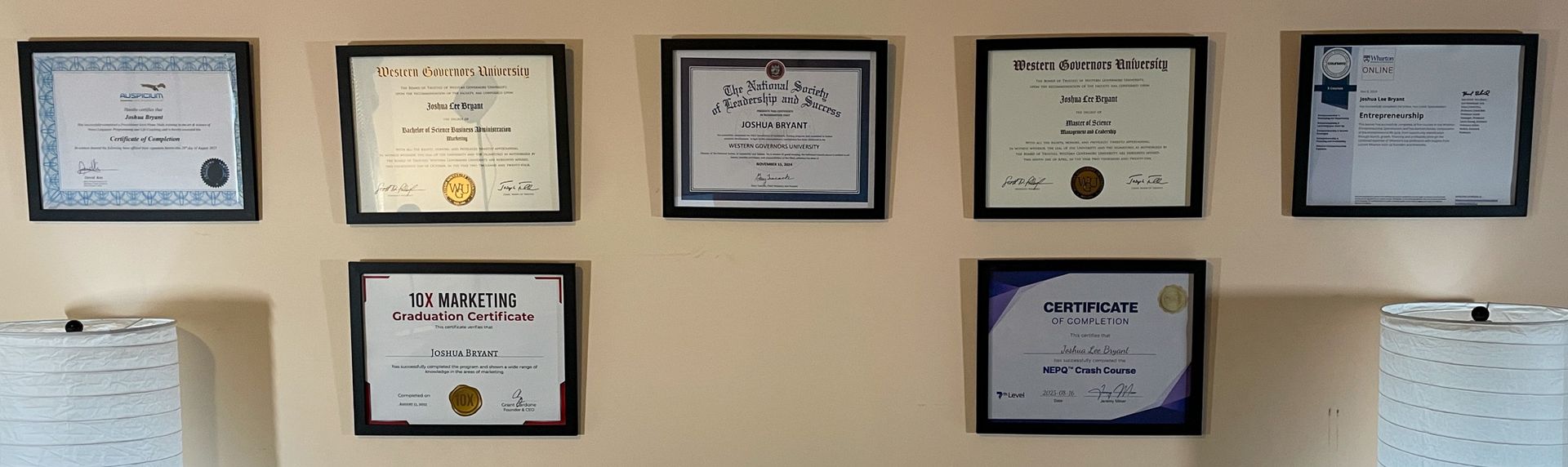
You need to be able to trust that the person helping your business is properly qualified to do the job, as your budget, brand, and growth are at stake. I’m a business major, author, and experienced mentor who has helped 200+ businesses and taught small business development workshops through organizations like the SBDC, People Inc, and the YWCA. Backed by formal education (MSML and a BSBA in Marketing), advanced training in business strategy and entrepreneurship, and certifications in marketing and sales frameworks, I bring both strategic depth and real-world execution to every engagement, so your growth plan is built on skill, not guesswork.

Free Consultation
Ready To Accelerate Your Business To New Heights? I'm here to help. Fill out this form and I will promptly reach out to you for a Free Consultation!